Wednesday, June 07, 2006

Reflections on Jim Nail's Visit To Class (Cymfony)

On Monday our class had the opportunity to hear Jim Nail, Chief Strategy and Marketing Officer, from Cymfony. Jim and I have been at some of the same WOMMA conferences but we've missed each other somehow so his visit to the class was the first chance we had to meet in person. He's incredibly sharp and a genuinely great person to carry on a conversation with.

All of the students in the class found his presentation extremely informative. His talk was called "Responding to Negative Buzz: The Whens, Wheres, and How Tos." As you can guess from the title he spoke about how to deal with negative WOM and provided some excellent suggestions about whether or not to respond to negative WOM in the blogosphere, how to respond (directly or indirectly), and the level of response required (for example, just in the blogosphere or beyond).

Among the most important points I took away was a clear set of criteria to decide if and how an organization should respond to negative buzz. For example, in order to determine whether or not you should respond a company should ask the following three questions:
1) How core is the issue to your brand, reputation, and business?
2) Is the post influential? (Jim provided various quantitative and qualitative ways to assess this).
3) Are comments defending you? How well are they making your case?

If the answer is yes to #1, yes to #2, and not very well to #3 then you definitely want to respond! Then he goes on to tell you how and where to communicate with detractors. He also discussed the importance of proactive outreach and engagement with key online influencers (including a special section on new rules when interacting with bloggers).

In addition to using numerous case studies from companies like Wal-Mart, FedEx, and Kryptonite, the students really enjoyed it when Jim spoke about his own experiences responding to negative buzz about Cymfony's Knowledge Center.

My favorite part though was when he talked about the future of WOM marketing. He actually gave a very seasoned assessment of the nascent industry and stated three things that could detract from the incredible growth of WOMM:
1) Marketers messing it up by employing stealth tactics (he also reviewed WOMMA's ROI Ethics Code).

2) Marketers' tendency to focus on where the money is (so if a lot of money is being spent on a big ad buy then that's where the attention is and not on the important communication, listening, and relationship-building aspects of the marketers' role);

3) Viewing blogs as just another channel for traditional "push" and "control" approaches to marketing.
It was clear that Jim took great care and thought in preparing this talk for my class and it was definitely appreciated by us all. It was also a preview of some new ideas that I didn't mention here because they won't be publicly released until June 19th, so stay tuned for that!

Jim's undergraduate major was geology and he attended Williams College in Western MA. Although you wouldn't know it by looking at him he graduated in 1978, 7-8 years before the students in my class were born! (Jim mentioned that he wasn't trying to hide his age -- now that's transparency!).

Thanks for joining us Jim! (And congrats on being elected to WOMMA's Board of Directors!)

-->
Tags:

Class 17 Agenda: Workshop: Designing WOM Program

17; Workshop: Designing WOM Program (Wednesday)

Learning Objective(s):
· To identify elements of a successful written proposal and presentation to client

Readings for This Class:
· No Readings

Content:
· Group meeting times. Professor will meet with each group for 15 minutes to finalize team’s approach.


Activities:
· Group Meeting Time (1 hour)
· Discuss written proposal and oral presentation to client.
· Identify elements of proposal.
· Run through sample oral presentation.

To Do (for next class):
· Chapter 6: Word-of-Mouth Storytelling. Dave Balter & John Butman. Grapevine: The New Art of Word-of-Mouth Marketing. 2005. Pages 115-133. (Bb)
· Suggested Reading: Quantifying the Ripple: Word-of-Mouth and Advertising Effectiveness. John E. Hogan, Katherine N. Lemon, & Barak Libai. 2004. Journal of Advertising Research, (September), 271-280. (Bb)

-->
Tags:

Tuesday, June 06, 2006

WOM and Employees


While I was wondering what to post for my next blog, I began searching the web for ideas. I googled WOM and advertising, wondering if I would find our class blog. Instead, I found a blog site that relates exactly with what we are learning in class (and its by womma). The blogsite is called word of mouth vs. advertising. It immediately caught my attention and I began browsing the posts.

The blog was originated to answer several questions for those companies and individuals curious about WOM marketing. Questions like "How does WOM impact your advertising?", "How does your advertising impact WOM?", "Does advertising inspire or inhibit WOM?", "Does product experience replace marketing?", etc. All the blog posts are exactly what we are learning and more.

A thought that I found extremely inspiring was in the first post I read. It talked about treating your employees well, because they, in turn, will treat your customers well. If you treat your employees poorly, chances are they are not going to be happy employees. And unhappy employees will not reflect well on the company during customer interactions. In class we focus on having a product or service that is worth talking about. This blog post went further. It never occurred to me that employees of a company, especially in retail and other customer service oriented jobs, are the ones having all the interactions with the consumers. A positive interaction with the company through an employee boosts the experience for the entire product/service. How many times have I gone to Friendly's, where the icecream is not entirely terrible, but the service is obnoxious? It is the terrible service experience leading the reason as to why I refuse to go to Friendly's anymore. And I tell all my friends not to go there also. I spread negative WOM for Friendly's based entirely on all my awful experiences there: waiting an hour for an icecream cone (which doesn't take that long to scoop), or waiting forever just to be seated. In this case, it is not the product driving the NWOM, but the employees. Which is the point of the blog post. I never looked at it in that perspective, but its entirely true (and pertinent to me and my vendetta against Friendly's).

Anyway, I advise you all to check out the site. The blogs are relevant to class and funny.
And something I thought was clever: keeping in the spirit of word of mouth, the site has a "Tell a Friend" link, where you can email your friends, spreading the word about the site!
-->
Tags:

Class 15 Agenda: Thiscompanysucks.com!: How To Deal With Negative WOM

15; Thiscompanysucks.com!: How To Deal With Negative WOM (Monday)


Learning Objective(s):
· To understand the amplification effect for online WOM
· To learn ways to track and monitor online WOM
· To identify methods of effective outreach and relationship building with online influencers
· To identify proactive and reactive strategies to address negative WOM

Readings for This Class:
· ThisCompanySucks.com: The use of the Internet in negative consumer-to-consumer articulations. Ainsworth Anthony Bailey. 2004. Pages 1-15. (Bb)
· Chapter 13: Blogging in a Crisis. Robert Scoble & Shel Israel. 2006. Pages 197-208. (NC)
· Suggested Reading: Chapter 7: The Weird Value of Negativity. Dave Balter & John Butman. 2005. Pages 141-164. (Bb)

Content:
· Guest Lecture: Jim Nail, Chief Marketing & Strategy Officer, Cymfony

Activities:
· Guest Lecture: Jim Nail, Chief Marketing & Strategy Officer, Cymfony

To Do (for next class):
· Readings:

o Chapter 8. Robert Scoble & Shel Israel. 2006. Pages 115-131. (NC)

· WOMES #2 Due by Class 16

-->
Tags:

Thursday, June 01, 2006

Class 14 Agenda: But How Do You Measure It? Seeking the Holy Grail of ROI for WOM Programs

14; But How Do You Measure It?
Seeking the Holy Grail of ROI for WOM Programs (Thursday)

Learning Objective(s):
· Measure and track ROI and other key outcome metrics for organized WOM programs.

Readings for This Class:
· The One Number You Need to Grow. Frederick Reicheld. Harvard Business Review. 2003. Pages 1-10. (Bb).
· London School of Economics. Advocacy Drives Growth. Brand Strategy. 2005. (Bb)
· Suggested Reading: Firm-Created Word-of-Mouth Communication: A Field-Based Quasi-Experiment. David Godes & Dina Mayzlin. 2004. HBS Marketing Research Papers No. 04-03. http://ssrn.com/abstract_id=569361 (Bb)
· Suggested Reading: A 10 Point Road Map to Planning and Measuring the ROI of WOM. Lauent Florès. 2005. Pages 113-122. (Bb)
· Suggested Reading: The ROI of WOM. Jeff Eisenberg. 2005. Pages 93-99. (Bb)
· Suggested Reading: Wharton School Publishing BzzCampaign. BzzAgent. 2005. Pages 1-4. (Bb)

Content:
· PPT: It’s the ROI Stupid! Emerging Metrics for WOM & CGM
· Group work on consulting project
· Mid-term feedback

Activities:
· Ask students to reflect on the outcome metrics that were used in the program they evaluated for the first main project.
· Brainstorming Ideas for DOWOMP Project: How would the company you analyzed build a program around the client problem? If the client went to that company, what do you think that company would have done?
· Two-minute Paper Activity for Midterm Feedback

To Do (for next class):
· Readings:

o ThisCompanySucks.com: The use of the Internet in negative consumer-to-consumer articulations. Ainsworth Anthony Bailey. 2004. Pages 1-15. (Bb)
o Chapter 13: Blogging in a Crises. Robert Scoble & Shel Israel. 2006. Pages 197-208. (NC)
o Suggested Reading: Chapter 7: The Weird Value of Negativity. Dave Balter & John Butman. 2005. Pages 141-164. (Bb)

o DOWOMP: Provide update to the client on your area of focus.


-->
Tags:

Wednesday, May 31, 2006

Class 13 Agenda: Understanding Online WOM and Blogs

13; Understanding Online WOM and Blogs (Wednesday)

Learning Objective(s):
· To understand three different approaches to how companies are using blogs and three different levels of involvement.
· To articulate objectives that can be accomplished through blogging.

Readings for This Class:
· Chapters 1-3 & Chapters 10 &11. Robert Scoble & Shel Israel. 2006. Pages 1-45, 149-180. (NC)
· Suggested Reading: Using Online Conversations to Study Word-of-Mouth Communication. David Godes & Dina Mayzlin. Marketing Science. 2004. Pages 1-17. (Bb)
· Suggested Reading: Utilizing the WOMMA Framework to Build a Syndicated Buzz Tracking Product. Jonathan Carson. 2005. Pages 71-76. (Bb)
· Suggested Reading: What Motivates People to Review a Product Online. Chrysanthos Dellarocas & Ritu Narayan. 2002. Pages 77-86. (Bb)
· Suggested Reading: The Effect of Word of Mouth on Sales: Online Book Reviews. Judith Chevalier & Dina Mayzlin. 2005. Pages 1-30. (Bb)

Content:
· Advantages and disadvantages of blogging
· Three ways companies are working with blogs and bloggers

Activities:
· Debrief Marketing Communications presentation (15 minutes)
· PPT Presentation: Blog Marketing: From Interruption to Engagement, From Control to Collaboration
· Meet with each group for 5 minutes to discuss their plans. (20 minutes)
· Return group projects from evaluating organized WOMM programs

To Do (for next class):
· The One Number You Need to Grow. Frederick Reicheld. Harvard Business Review. 2003. Pages 1-10. (Bb).
· London School of Economics. Advocacy Drives Growth. Brand Strategy. 2005. (Bb)
· Suggested Reading: Firm-Created Word-of-Mouth Communication: A Field-Based Quasi-Experiment. David Godes & Dina Mayzlin. 2004. HBS Marketing Research Papers No. 04-03. http://ssrn.com/abstract_id=569361 (Bb)
· Suggested Reading: A 10 Point Road Map to Planning and Measuring the ROI of WOM. Lauent Florès. 2005. Pages 113-122. (Bb)
· Suggested Reading: The ROI of WOM. Jeff Eisenberg. 2005. Pages 93-99. (Bb)
· Suggested Reading: Wharton School Publishing BzzCampaign. BzzAgent. 2005. Pages 1-4. (Bb)

-->
Tags:

Tuesday, May 30, 2006

Class 12 Agenda: Designing Organized WOM Programs: Overview

12; Designing Organized WOM Programs: Overview (Tuesday)

Learning Objective(s):
· To identify key decision-making factors when deciding which WOM company to partner with
· To understand how WOM fits within a broader marketing communication strategy

Readings for This Class:
· Part Three of The Anatomy of Buzz. Emanuel Rosen. 2000. Pages 133-261. (AOB)

Content:
· Guest lecture
· Group meetings with client

Activities:
· Guest Lecture: Brian Kenny, Vice President of Marketing Communications at Northeastern University
· Collect homework assignment of three ideas each consulting team has for the WOM program and three pieces of information needed from the client
· Group Meetings with Client: Groups will meet with their client contact person for 15 minutes to discuss the cases and pose questions to the client.

To Do (for next class):
· Chapters 1-3 & Chapters 10 &11. Robert Scoble & Shel Israel. 2006. Pages 1-45, 149-180. (NC)
· Suggested Reading: Using Online Conversations to Study Word-of-Mouth Communication. David Godes & Dina Mayzlin. Marketing Science. 2004. Pages 1-17. (Bb)
· Suggested Reading: Utilizing the WOMMA Framework to Build a Syndicated Buzz Tracking Product. Jonathan Carson. 2005. Pages 71-76. (Bb)
· Suggested Reading: What Motivates People to Review a Product Online. Chrysanthos Dellarocas & Ritu Narayan. 2002. Pages 77-86. (Bb)
· Suggested Reading: The Effect of Word of Mouth on Sales: Online Book Reviews. Judith Chevalier & Dina Mayzlin. 2005. Pages 1-30. (Bb)

-->
Tags:

Thursday, May 25, 2006

Brains on Fire Reflection

--> As we all know, our class recently finished our first major WOM marketing project. My group analyzed Brains on Fire's Rage Against the Haze anti-teen smoking campaign. I think everyone in the group took away different things from the campaign that they considered to be the most important. We all learned a lot about creating effective and successful WOM and viral marketing campaigns.

In our group papers, we had to identify what our company had learned from the campaign. Then we had to apply what they learned to our own group's hypothetical future design of a word of mouth project. Well I would like to share what I learned from, and consider to be the most important aspect of, Brains of Fire's RAGE program.

Brains on Fire approached the project with a specific vision. The vision was to have the teens of South Carolina to spread the word against smoking to the other teens. Because as we all know, if an adult says it's uncool, it's cool. If a peer says it's uncool, then it becomes uncool. Brains on Fire identified and recruited RAGE candidates to assist the movement. By doing this, Brains on Fire identified and engaged their movement Influencers. Now here comes what I consider to be the ingenious part of the plan. Brains on Fire took their teen influencers and created a program that would teach them to become even better influencers. They taught the teens (through a top secret program) how to effectively utilize the WOM tools provided. They taught the teens how to generate buzz and increase RAGE awareness. By doing this, Brains on Fire created the necessary RAGE influencers and program environment. They took the tools they had to create a more sustainable movement. They did not just locate influencers, they made more effective ones. This is what ultimately led to the success of the movement. Their teens were pros at recruiting new members and spreading the RAGE word. Brains on Fire didn't just take what they could get, they designed a program to make what they needed.

This lesson is what I learned from Brains on Fire. Think outside the box. There are tools staring you in the face, you just have to cultivate the idea. Of course the situation changes, and the application can not always be to just train your influencers (because as we learned in class, this is not always considered ethical). However, find an aspect of the program that you can manipulate to increase your WOM program's success.
Tags:

Reflections on Brad Fay's Visit To Class (Keller Fay Group)

On Tuesday we were fortunate to have Brad Fay from the Keller Fay Group come in to talk with us about the notion of the "influentials." In his former position at GfK NOP World Brad had done a lot of interesting work on the "Influential Americans" and the difference between social influencers versus category-specific influencers. We were also able to hear Brad talk about the new company that he co-founded with Ed Keller, the Keller Fay Group and their TalkTrack methodology.

Students got a taste of what the world of market research is all about and it served as a nice contrast to the campaign design work from our earlier guest speaker, Steve Curran from Pod Design.

Here are the four key points I took away from Brad's talk:

- Brad gave us a helpful way to identify influencers, regardless of whether they are "social" influencers, "category" influencers, or "brand" influencers. The common characteristics are: 1) a degree of social connectivity (for example, how many close friends a person has, if they are "joiners," how many e-mails you get from different people, etc.); 2) being a source of advice for other people; 3) being an information-gatherer; and potentially you can add in have specific knowledge or experience in a particular category. This will really helpful as the students think about identifying influencers in their own organized WOMM program design (we also connected it to Emanuel Rosen's handy mnemonic to identify network hubs: ACTIVE; see Anatomy of Buzz for details).

- We asked him about the 10% statistic for the "Influential Americans" and whether or not that 10% applied to influencers in a particular category. He gave the best answer I've heard of this by explaining that you have to understand influencers on a continuum. The 10% line represents a certain amount of influence, but you could also cut the line at 5% or 25%. If it's 5% then you're looking at people who might have much more influence in their social networks while if you use 25% then the level of influence might not be as strong. A company might want to define influence more broadly or narrowly depending on their goals and thus you might draw the line at different places (some company's business models might want to focus on the top 1-2%!).

- A student asked him what their major should be if they want to get into his line of market research work. He had a great response. He said it was less about the major and more about your level of curiosity. He said that market research can be a little "geeky" and that the people who can stay in it over the long term and thrive need to be the type of people who get excited about what makes people tick and what's going on in the world around them. He went on to say if you're the type of person who, when you're doing a research project, just can't wait to get the "tabs" (tabulations) back and maybe even make friendly bets about what the findings might be, then you're the type of person who is a good fit for market research. He then asked the students how many people that might be. In a class of 18 students about 3 raised their hand. He then said, "Yep, that's about right!" :-)

- Finally, I loved Brad's point about reporting results back to a client. He said that in a written proposal or a presentation to the client you want to tell a story. Clients come to market research firms with problems to be solved and Brad said that your report has to frame any report in the context of a story that presents an answer to the clients' problem.

Brad's undergraduate major was Political Science and he did his master's degree at the University of Connecticut, studying with Bud Roper, son of Elmo Roper.

Thanks for joining us Brad!

-->
Tags:

Reflections on Steve Curran's Visit To Class (Pod Design)

Last week Steve Curran from Pod Design came into speak with our class on viral marketing and branded entertainment. Steve and I had met last year as part of a panel on WOM for the Promotion Marketing Association. I knew that Pod had done a lot of interesting work for companies to engage, entertain, and stimulate pass-along among consumers so I was looking forward to his talk. In fact one of his company's recent projects (Peerflix Paparazzi game) won the top spot in the 2006 Marketing Sherpa Viral Marketing Hall of Fame. We also read Steve's chapter in the Connected Marketing book.

Students really enjoyed his talk as he used a lot of great examples and case studies. They were also impressed with the company's list of clients (Warner Brothers, Atlantic Records, Tweeter, etc.). Here are a few points I took away from his visit:

- Steve sees his company in the business of creating "conversation pieces." These could be online games, branded sites, or other online user "experiences" that lead people to conversations about the brand.

- When designing a campaign he said you have to find the "hot buttons" in culture and then "press them." They did this with a line of natural beauty treatment products for the "Making Over Mona" campaign. The cultural hot button here at the time was all the discussions about botox, collagen, and chemical peels. The point of the campaign was that you wouldn't want to use these on a masterpiece like the Mona Lisa so why do it to your own face? This campaign generated a lot of buzz for the Dr. Comenge line.

- "Porn is just one click away." Steve's point was that in the online world there are many things competing for people's attention and any viral marketing campaign that is conducted must engage and entertain people. If it doesn't then people will move on to more "interesting" things.

- And the most interesting point for me was his discussion about an ROI metric: number of minutes of customer engagement (I must be the geek in the crowd if I get excited about a ROI metric). With all the interest about engagement in the advertising industry one metric that Steve's company can show their clients is how long people are engaged with the advergame or branded site. This length of time is often significantly longer than people would stay engaged with more traditional advertising and marketing approaches.

Steve's majors in college were Visual Communications and Graphic Design with a minor in Advertising. (Students love to know this information so I ask it of every guest speaker if they don't get to ask the speaker first!).

Thanks for joining us Steve!

-->
Tags:

Class 11 Agenda: Practitioner Perspective: A Client’s View On Selecting WOM Marketing Companies

11; Practitioner Perspective: A Client’s View On Selecting WOM Marketing Companies (Thursday)

Learning Objective(s):
· To identify key phases of consulting engagement

Readings for This Class:
· A Note to New Consultants. Bruce Henderson. 1970s. Pages 1-3. (Bb)
· How to manage connected marketing. Martin Oetting. 2006. Pages 232-266. (Bb)

Content:
· Basic Consulting Framework
· Review Designing Organized WOMM Assignment
· Form project groups around case study from NU Marketing Communication

Activities:
· Presentation of cases from NU Marketing Communications Group
Brian Kenny – VP of Marketing & Communications
Ann Comer – Associate Director, Marketing Programs (Athletics; also with Bianca Glitworth who will come in on Tuesday)
Alyssa Meritt – Associate Director of Interactive Marketing (Alumni)


To Do (for next class):
· No Class – Memorial Day
· For Tuesday, reflection essay due with peer evaluation sheets. [Changed to be due on Wednesday].
· For Tuesday, come prepared with three ideas for the organized WOMM program and also three questions or pieces of information need from the client.
· Print two copies of this sheet with your name on it.
· For Tuesday, read Rosen Part 3. Part Three of The Anatomy of Buzz. Emanuel Rosen. 2000. Pages 133-261. (AOB) [Focus on pp. 249-261]

-->
Tags:

Wednesday, May 24, 2006

Class 10 Agenda: Key Company Players in the WOMM Space and the Concepts & Principles That Inform Their Organized WOMM Programs

10; Key Company Players in the WOMM Space and the Concepts & Principles That Inform Their Organized WOMM Programs (Wednesday)

Learning Objective(s):

· To explain an organized WOM program in light of the WOMMA Terminology Framework
· To articulate how an organized WOMM program leverages WOM principles
· To apply lessons learned from evaluating a company’s organized WOMM program to designing one’s own WOMM program

Readings for This Class:

· No Readings

Content:

· Student presentations

Activities:

· Presentation order:
1. Brains on Fire Rage Against the Haze
2. BzzAgentRadica Games’ 20Q
3. Church of the Customer Discovery Network
4. MatchstickWine Council of Ontario’s VQA
5. M80Family Guy

· Describe the company in terms of its mission, their clients, and the services they provide (300-500 words)
· Describe the type of WOMM program in terms of the techniques used (see http://www.womma.org/wom101b.htm; 100-200 words)
· Describe the characteristics of the WOMM program in terms of the WOMMA Terminology Framework (specifically, Participants, Venues, WOMUnits, Actions, and Outcomes; 500-700 words).
· Identify and discuss the goals of the program (100-200 words).
· Identify and discuss the specific methods and/or metrics used to measure the success of the program (300-500 words).
· Identify and discuss the WOM principles leveraged in the program to make it successful (300-500 words).
· Identify any lessons the company learned from the program and how it could apply to your group designing its own organized WOMM program (at least 2 points; 500-700 words)
· Does your group consider this program to be a success? If so, why? If not, why not? (150 - 250 words)
· From your group’s perspective what would your group have done differently with the program design or evaluation? (Identify at least two points; 300-500 words).

To Do (for next class):

· Readings:
o A Note to New Consultants. Bruce Henderson. 1970s. Pages 1-3. (Bb)
o How to manage connected marketing. Martin Oetting. 2006. Pages 232-266. (Bb)


-->
Tags:

Tuesday, May 23, 2006

Class 9 Agenda: Influentials: Fact, Fiction, Or Cultural Narrative?

09; Influentials: Fact, Fiction, Or Cultural Narrative? (Tuesday)

Learning Objective(s):

• To distinguish among social influentials, category influentials, and brand influentials.
• How to apply market research insights on influential to strategic WOM marketing programs

Readings for This Class:

• The Influentials: Introduction. Ed Keller & Jon Berry. Pages 1-25. (Bb)
• People Who Influence People: Criticism and Modifications. Gabriel Weimann. 1994. Pages 239-254. (Bb)
• Suggested Reading: The Influentials: Developing an Influential Strategy. Ed Keller & Jon Berry. Pages 279-340. (Bb)
• Suggested Reading: People Who Influence People: Opinion Leaders in Marketing. Gabriel Weimann. 1994. Pages 109-138. (Bb)
• Suggested Reading: Grapevine: Chapter 5: The Myth of the Influentials. Dave Balter & John Butman. Pages 91-111. (Bb)

Content:
• Guest Lecture

Activities:
• Guest Lecture: Brad Fay, The Keller Fay Group


To Do (for next class):
• No Readings
• Prepare for Evaluating Organized WOMM Program report and presentations


-->
Tags:

Monday, May 22, 2006

FAQ: WOMUnits, Topicality, and the WOMMA Terminology Framework

As students ask questions to me via e-mail that I think will be relevant to all students I will post the questions and my responses as part of the class blog. This will be a useful way to develop a public knowledge base and resource.

Here's a question I received about the WOMMA Terminology Framework and specifically the characteristic of Topicality.

In all the FAQ posts I will make the students' identity anonymous.
Dr. Carl,

As I'm working on our group's WOMM campaign paper, discussing the campaign in terms of the WOMMA terminology framework, I'm having trouble understanding the meaning of the word topicality (as it applies to WOMUnits). Quite frankly, I'm still not convinced that topicality (much like WOMUnit) is even a real word.

Could you please provide some clarification to the meaning of this word?? The definition in the WOMMA reading is unclear and the definitions don't do much to support it.

Thanks, XXXX
And here's my response:
Hi XXXX,

While WOMUnit is clearly a "clunky" term (which refers to the message in a WOM episode), topicality is pretty straightforward once it's explained properly. Basically think about it as being a message that is "on topic." Of course, "on topic" is always in the context of a "desired" message relative to some person, group, or organization. So think about if there's a campaign where the marketer wants to get a message out about the health benefits of a product. If people end up talking about the health benefits then the WOMUnits, or messages, created by the Participants are "on topic" because they are consistent with the desired message the marketer wanted to get across originally.

What has high topicality to one group might have low topicality to another. Think about the Chevy Tahoe campaign we discussed in class. If people made videos about how cool the SUV was and all that it allowed people to do, those consumer generated videos would have high topicality from Chevy's perspective. However, many of the videos were "spoof" ads and talked about how the vehicles were anti-environment and gas-guzzlers. From Chevy's perspective the WOMUnits (the consumer generated videos) had low topicality, but from the creators' perspective that WOMUnit has high topicality because it's consistent with the message that person or group wants to get across.

I hope that helps! Let me know if you have any questions.

Dr. Carl
-->
Tags:

Class 8 Agenda: WOM Practitioner Principles and Frameworks: Ideaviruses & Customer Evangelism

08; WOM Practitioner Principles and Frameworks:
Ideaviruses & Customer Evangelism (Monday)

Learning Objective(s):
Identify six tenets of customer evangelism
· Apply six tenets to case study analysis
· Identify principles of ideaviruses
· Differentiate two emerging industry philosophies regarding WOMM

Readings for This Class:

· The Customer Evangelism Manifesto. Ben McConnell & Jackie Huba. 2003. Pages 1-20. (Bb)
· Chapter 12: The New Mavericks of Marketing. Ben Connell & Jackie Huba. 2003. Pages 123-138. (Bb)
· Unleash Your Ideavirus. Seth Godin. 2000. Pages 1-7. (Bb)

Content:

· Six tenets of customer evangelism
· How to create an ideavirus and a purple cow
· Emerging philosophies of WOM: WOM Creationists v. WOM Evolutionists and New Traditionalists v. WOM Progressives

Activities:

· Go over details of the presentation.

· Presentation should be 10 minutes with 5 minutes of Q&A from the
audience.
· Include word count on cover page of report.

· PPT Lecture: Review six tenets of customer evangelism
· Discussion: Case study (Dallas Mavericks)
· PPT Lecture: Review ideavirus principles and Purple Cow principles
· Discussion: Philosophies of WOM:

· WOM Creationists v. WOM Evolutionists
· New Traditionalists v. WOM Progressives


To Do (for next class):

· The Influentials: Introduction. Ed Keller & Jon Berry. Pages 1-25. (Bb)
· People Who Influence People: Criticism and Modifications. Gabriel Weimann. 1994. Pages 239-254. (Bb)
· Suggested Reading: The Influentials: Developing an Influential Strategy. Ed Keller & Jon Berry. Pages 279-340. (Bb)
· Suggested Reading: People Who Influence People: Opinion Leaders in Marketing. Gabriel Weimann. 1994. Pages 109-138. (Bb)
· Suggested Reading: Grapevine: Chapter 5: The Myth of the Influentials. Dave Balter & John Butman. Pages 91-111. (Bb)

-->
Tags:

Thursday, May 18, 2006

Class 7 Agenda: Viral Marketing and Stimulating WOM and Pass-Along Via Online Gaming

07; Viral Marketing and Stimulating WOM and Pass-Along Via Online Gaming (Thursday)

Learning Objective(s):

· To distinguish WOM, buzz, and viral marketing communication
· To understand principles behind viral marketing
· To understand how viral marketing campaigns are executed

Readings for This Class:

· Viral Marketing. Justin Kirby. Pages 87-106 (CM)
· Changing the Game. Steve Curran. 2006. Pages 129-147. (CM)
· Suggested Reading: Online opinion leaders: a predictive guide for viral marketing campaigns. Idil Cakim. 2006. Pages 107-118. (CM)

Content:

· Lecture on viral marketing


Activities:

· Guest Lecture: Steve Curran, Pod Design

To Do (for next class):

· The Customer Evangelism Manifesto. Ben McConnell & Jackie Huba. 2003. Pages 1-20. (Bb)
· Chapter 12: The New Mavericks of Marketing. Ben Connell & Jackie Huba. 2003. Pages 123-138. (Bb)
· Unleash Your Ideavirus. Seth Godin. 2000. Pages 1-7. (Bb)


-->
Tags:

Wednesday, May 17, 2006

A Singularly Bad Cell Phone Service

--> Cell phone companies. T-Mobile. Alltel. Verizon. . . Cingular- "raising the bar" with the "fewest dropped calls". A short while ago, I used to be a Cingular customer. When I signed up I chose a two year contract. Worst two years ever. Two years bound to a pain inflicting company. Cingular may not drop your calls, but they sure do charge for roaming. I would rather have my call dropped and know that I had no service, than get charged $300 every month for roaming. And if I began roaming while I talking on my cell, there was no kind of warning system. No beeping or blinking of any kind to warn me to hang up because of astronomical charges quickly accruing on my account. I would unknowingly talk and roam everyday. And pay for it.
Furthermore, I would roam in places that should have gotten adequate service. I mean, this is Boston, a metropolitan city. Not middle-of-nowhere Wisconsin cow fields.

And as for this so-called bar that is being raised- I do not think it is being raised above and beyond to superior service. But rather, it is slowly being raised to where service should have been to begin with. In my own apartment, my phone would rotate between one bar and no service. Cingular should work on raising that one bar I had, to five whole bars- full service. Once they accomplish the task of literally raising customer's bars, they can use the slogan "raising the bar" and mean it.

Now that my two years are over, I have Verizon. I get service everywhere. Moreover, Verizon has no roaming. And since I've had Verizon, none of my calls have been dropped.
And that's not gossip, it's fact.
Tags:

Class 6 Agenda: Evaluating WOMM Programs

06; Evaluating WOMM Programs (Wednesday)

Learning Objective(s):


· To articulate three principles to explain social epidemics
· To articulate two WOM principles to explain the effectiveness of seeding trials
· To contemplate the ethics of seeding trials in the name of “research”


Readings for This Class:


· Connected Marketing Practice: Seed to spread: how seeding trials ignite epidemics of demand. Marsden. 2006. Pages 3-23. (CM or Bb)


Content:

· Tipping Point principles of social epidemics
· Explanations for effectiveness of seeding trials
· Methods of identifying opinion leaders
· 10-point checklist for creating seeding trials


Activities:

· PPT Lecture: Evaluating WOM Programs
· Activity: Create Your Own Seeding Trial
· Discussion: Do seeding trials truly empower consumers? Is it ethical to call seeding trials “research”?


To Do (for next class):


· Viral Marketing. Justin Kirby. Pages 87-106 (CM)
· Changing the Game. Steve Curran. 2006. Pages 129-147. (CM)
· Suggested Reading: Online opinion leaders: a predictive guide for viral marketing campaigns. Idil Cakim. 2006. Pages 107-118. (CM)

-->
Tags:

Tuesday, May 16, 2006

Class 5 Agenda: Haven’t We Always Known About WOM? Tracing the History of Academic and Popular Press Ideas of WOM, Loyalty, and Advocacy

05; Haven’t We Always Known About WOM? Tracing the History of Academic and Popular Press Ideas of WOM, Loyalty, and Advocacy (Tuesday)

Learning Objective(s):

  • Identify the primary academic research traditions that inform WOM marketing communication

Readings for This Class:

  • Word of Mouth: What We Really Know – And Don’t. Greg Nyilasy. 2006. Pages 161-184. (CM).
  • What’s All the Buzz About? Everyday Communication and the Relational Basis of Word-of-Mouth and Buzz Marketing Practices. Walter J. Carl. Management Communication Quarterly, 19(4), 601-634. 2006. (Bb)
  • Suggested Reading: Word-of-Mouth: Understanding and Managing Referral Marketing. Francis Buttle. Journal of Strategic Marketing, 6, 241-254. 1998. (Bb).
  • Suggested Reading: Social Hubs: A Valuable Segmentation Construct in the Word-of-Mouth Consumer Network. Andrea C. Wojnicki. 2004. Advances in Consumer Research, 31, 521-522. (Bb)

Content:

  • Opinion leadership
  • Diffusion research
  • Social network research
  • Nyilasy’s four quadrants of academic WOM research
  • Loyalty and WOM (discuss in Quadrant III)
  • Social consequences of interpersonal influence model
  • Conversational geography of word-of-mouth project

Activities:

To Do (for next class):

  • Readings:
  • Connected Marketing Practice: Seed to spread: how seeding trials ignite
    epidemics of demand. Marsden. 2006. Pages 3-23. (CM or Bb)
    • Complete WOMES #1 by tomorrow

    -->
    Tags:

    Monday, May 15, 2006

    Class 4 Agenda: WOM Basic Principles

    04; WOM Basic Principles (Monday)

    Learning Objective(s):

    • To distinguish between word-of-mouth and buzz marketing.
    • To articulate the implications of networked-based principles of WOM
    • To apply networked-based principles of WOM to the evaluation of organized WOMM programs

    Readings for This Class:

    • Part One of The Anatomy of Buzz. Emanuel Rosen. 2000. Pages 2-99 (AOB)
    • Suggested Reading: Where’s Debbie? How Consumers Influence Each Other and Practical Steps Brands Can Take to Understand and Harness Word of Mouth. MediaLab. 2004. (Bb)
    • Suggested Reading: The Firm’s Management of Social Interactions. David Godes et al. Marketing Letters, 16(3/4), pp. 415-438. 2005. (Bb)

    Content:

    • Definitions of WOM versus buzz
    • Rosen’s 10 Network-based Principles of WOM
    • WOM Characteristics of Network Hubs

    Activities:

    • [From Class 03: Finish debrief of WOMMA Terminology Framework activity]
    • Get update on Evaluating Organized WOMM Program Assignment. How is the research going so far? Have interviews with been scheduled yet?
    • Discuss Part I of Rosen’s Anatomy of Buzz
      How does Rosen define “buzz”? Compare and contrast this definition with Newsweek’s definition, as well as with WOMMA’s definitions of WOM marketing and buzz marketing?
      Rosen argues that it’s essential to adopt a network perspective in order to understand WOM. What are the alternatives do you agree or disagree with his perspective?
    • Identify Rosen’s 10 principles of networks and their implications to WOMM. Think through how each principle applies to the organized WOMM program you are evaluating.

    1. Networks are invisible

    2. Nodes of network are characterized by similarity (homophily)

    3. Networks are composed of clusters (cliques)

    4. Buzz spreads through common nodes (“small world phenomena”)

    5. Information can get trapped in clusters (structural holes: “a separation between non-redundant contacts), Ronald Burt)

    6. Network hubs and connectors create shortcuts (liaisons)

    7. Physical proximity affects who talks with whom

    8. Strength of weak ties (Mark Granovetter)

    9. Internet nurtures weak ties

    10. Networks cut across markets

    • Network hubs and their characteristics (ACTIVE mnemonic)
    • Similar to “opinion leaders” but critiques inferences associated with leaders. Hubs are defined in terms of their centrality in a network.
    • Rosen’ Network Hubs:
      Ahead in adoption
      Connected
      Travelers
      Information hungry
      Vocal
      Exposed to media
    • How buzz spreads
    • It starts with a great product or service
    • Energy of Participants spreading word
    • Credibility of Participants (importance of third parties and competitor
      recognition)

    To Do (for next class):

    • Think through lunches you want to, and can, attend with guest lecturers.
    • First Lunch: Steve Curran, Pod Design. Thursday, May 18th.
    • Readings:
    • Word of Mouth: What We Really Know – And Don’t. Greg Nyilasy. 2006. Pages 161-184. (CM).What’s All the Buzz About?
    • Everyday Communication and the Relational Basis of Word-of-Mouth and Buzz Marketing Practices. Walter J. Carl. Management Communication Quarterly, 19(4), 601-634. 2006. (Bb)
    • Suggested Reading: Word-of-Mouth: Understanding and Managing Referral Marketing. Francis Buttle. Journal of Strategic Marketing, 6, 241-254. 1998.
      (Bb).
    • Suggested Reading: Social Hubs: A Valuable Segmentation Construct in the Word-of-Mouth Consumer Network. Andrea C. Wojnicki. 2004. Advances in Consumer Research, 31, 521-522. (Bb)

    -->
    Tags:

    Thursday, May 11, 2006

    Class 3 Agenda: Overview of WOM Industry Companies & WOMMA Terminology Framework

    03; Overview of WOM Industry Companies & WOMMA Terminology Framework (Thursday)

    Learning Objective(s):
    • Apply WOMMA terminology framework to characterize an organized WOMM program
    • Demonstrate understanding of key issues surrounding the WOMM industry

    Readings for This Class:
    • Word of Mouth Marketing Association Terminology Framework. WOMMA. 2005. (Bb)
    • Suggested Reading: Word-of-Mouth Marketing Priorities for 2006. Peter Kim & Charlene Li. 2006. (Bb)

    Content:
    • WOMMA Terminology Framework

    Activities:
    • Pick up from last class about key challenges and priorities for WOMM industry
    o Also take questions on any of the readings
    Activity: Applying WOMMA Terminology Framework to Organized WOM Marketing Program
    • Assign WOM Diary
    o Sign-up for 4-digit IDs.

    To Do (for next class):
    • Continue research on your organized WOMM programs
    • Readings:
    o Part One of The Anatomy of Buzz. Emanuel Rosen. 2000. Pages 2-99 (AOB)
    o Suggested Reading: Where’s Debbie? How Consumers Influence Each Other and Practical Steps Brands Can Take to Understand and Harness Word of Mouth. MediaLab. 2004. (Bb)
    o Suggested Reading: The Firm’s Management of Social Interactions. David Godes et al. Marketing Letters, 16(3/4), pp. 415-438. 2005. (Bb)


    -->
    Tags:

    How Students Learned About the Class

    On the first day of class while we were doing the roll I asked the 18 students enrolled how they learned about the course. Here's what we found:

    From a Professor -- 4
    From an Advisor -- 4
    Through Friends -- 3
    Online Catalog -- 3
    E-mail Blast from Department -- 3
    MyNEU Announcement, the online student portal (generated by Department) -- 1

    Personal sources accounted for 11/18, or 61%
    Impersonal, electronic sources accounted for 7/18, or 39%


    I had asked the first few students who were enrolled in the course early on to tell their friends about it so that we could ensure we obtained the minimum number of students (n=10). This seemed to work because the "through friends" all came as a result of one student who was one of the first four to sign up for the class. The student he told also told another student so we had an instance relay/pass-along.

    But it seemed the most effective was via professors and advisors, people who are arguably influential based on their structural network position in the organization and any credibility factors derived from their personal characteristics or existing relationships with the students.

    As part of the debrief of this mini-activity we also discussed the different motivations for passing along positive and negative WOM as reported in Sundaram et al., Advances in Consumer Research, Volume 25, 1998:
    - altruism, product (or service or brand experience) involvement, self-enhancement, and helping the company (for positive WOM)

    - altruism, anxity reduction, advice seeking, and vengeance (for negative WOM)
    For example, one student said he had a positive experience with me in a prior class which led him to spread the word to others (an instance of "product" involvement).

    I love little activities like this to practically illustrate basic concepts and principles of word-of-mouth.

    -->
    Tags:

    Wednesday, May 10, 2006

    Class 2 Agenda: CGM & WOM: The Birth and Rise of an Industry

    Here's the agenda for our second class...

    02; CGM & WOM: The Birth and Rise of an Industry (Wednesday)

    Learning Objective(s):

    • Identify factors contributing to the recent resurgence in WOM;
    • Articulate how WOM is both a set of activities and a larger philosophy;

    Readings for This Class:
    WOM 101. Word of Mouth Marketing Association. 2005. (Bb)
    Consumer Generated Media (CGM) 101: Word-of-Mouth In the Age of the Web-Fortified Consumer. Pete Blackshaw and Mike Nazarro. 2004. (Bb)
    • Introduction and Summary. Paul Marsden. 2006. Pages xv – xxxv. (CM)

    Content:
    • Distinguish among WOM, buzz, and viral marketing.
    • Identify different kinds of WOM marketing

    Activities:


    • Review syllabus
    o Go over schedule
    o Discuss blogging participation

    • Discuss Evaluating WOM Program
    o Form groups based on program interest
    - Invite class to decide on numbers in each group so that we can cover all five companies
    - Discuss public/private nature of the information the companies are sharing with us.

    • Finish Introduction to WOM & CGM PowerPoint lecture
    o Go over challenges ahead of the industry and emerging visions (New Traditionalists versus WOM Progressives)
    o Discuss organic versus amplified
    o Types of WOMM

    • Discuss class readings
    o Product advocacy, not campaign buzz, is what drives growth (or is at least correlated with growth) (p. xxvi of CM)
    o To decide whether or not a product or service is appropriate for a WOMM campaign think about whether or not it’s worth recommending. (CM)
    o Create something remarkable (CM)
    o CGM leaves a “digital trail” which makes it easier to measure. For example, CGM can be used to track the effects of other elements of the marketing plan (p. 10)
    o MoveOn.org create-a-campaign v. Chevy Tahoe ad
    o Monitoring CGM:
    - Identify who’s speaking
    - Identify and flag key issues
    - Deepen relationship marketing efforts

    To Do (for next class):
    • Create Bloglines account
    o Add class feed

    • Begin research for Evaluating WOM Program (log into Bb to access resources)

    • Read:
    o Word of Mouth Marketing Association Terminology Framework. WOMMA. 2005. (Bb)
    o Suggested Reading: Word-of-Mouth Marketing Priorities for 2006. Peter Kim & Charlene Li. 2006. (Bb)


    -->
    Tags:

    Tuesday, May 09, 2006

    Class 1 Agenda: Introduction

    Here is the agenda for the first class today. I'll post these so that people who want to follow the class but can't attend (or were absent) can see what we're up to each day. Links to handouts or PowerPoint presentations will also be provided as relevant. We had 17 students enrolled in the class and all were in attendance!

    01; Introduction (Tuesday)

    Learning Objective(s):
    • Identify factors contributing to the recent resurgence in WOM;
    • Articulate how WOM is both a set of activities and a larger philosophy;

    Readings for This Class:
    • None

    Activities:

    • Take roll

    • Take out a sheet of paper. How did you learn about this class? Poll students.
    o If that person heard it from someone else, how did they learn about it?
    - Illustrate networks and pass-along.
    o Why did that person tell you?
    - Illustrate why we are motivated to engage in WOM.

    PowerPoint Presentation: Introduction to WOM & CGM

    • Pass out syllabus

    • Go over assignments

    • Assign Evaluate Organized WOM Program & Company Project
    o Brains on Fire (Program: Rage Against the Haze)
    o BzzAgent (Program: Radica Games' 20Q)
    o Church of the Customer (Program: Discovery Educator Network)
    o Matchstick (Program: Wine Council of Ontario's VQA)
    o M80 (Program: Family Guy)

    To Do (for next class):

    • Visit WOMMA website, subscribe to WOMNIBUS, etc.

    • Reflect on your groups and which program you want to analyze. Visit class blog post.

    • Read:

    o WOM 101. Word of Mouth Marketing Association. 2005. (Blackboard)
    o Consumer Generated Media (CGM) 101: Word-of-Mouth In the Age of the Web-Fortified Consumer. Pete Blackshaw and Mike Nazarro. 2004. (Blackboard)
    o Introduction and Summary. Paul Marsden. 2006. Pages xv – xxxv. (Connected Marketing; also available on Blackboard if you don’t have the book yet)

    -->
    Tags:

    Monday, May 08, 2006

    Always Look On The Bright Side of Life

    I like to think of myself as a fairly organized person with a relatively high level of attention-to-detail. OK, let's be honest, some would call this "anal," but I'll cut myself some slack and go with "organized."

    This is why I was surprised to learn today that the first day of summer session one started on Tuesday and not Thurdsay like I originally thought.

    After several moments of "Ha!, you must be mistaken..." and "No, I'm sure I read the calendar right" I realized I better ask around: "Are you sure the semester starts tomorrow?" and "I knew there wasn't much of a break between graduation and the start of the summer term, but three days, really?". I was sure I read the university calendar correctly but after going back again I saw that it said Tuesday, May 9th, in black and white. I finally acquiesced to the fact that I missed this minor detail, leaving a blemish on my organized, A-T-D sense of self. And oh yeah, I had less than 24 hours before my first class.

    Fortunately I am anal, er, organized, and so most of the class was ready to go anyway. But it was a frantic afternoon nonetheless. Fortunately my research assistant, Jenn, helped out tremendously. We revised the syllabus, updated Blackboard, the online course management system, and a thousand other minor things to get ready for class. And now we're good to go!

    The upside of all this is that we have two more days to learn about a topic near and dear to my heart. If I hadn't messed up the date I'm sure I would have tried to add in that extra topic into an already jam-packed syllabus, so serendipitously discovering these extra two days will actually give us some much needed breathing room at the beginning of the class.

    So, in honor of that great Broadway musical, Spamalot, the lesson learned here is: always look on the bright side of life (don't forget to whistle!)

    Friday, May 05, 2006

    Class Assignment: Evaluating Organized Word-of-Mouth Marketing Programs

    If you're joining us from the invitation via my research blog, welcome!

    I am excited to announce the first major assignment that my students will be working on. Their task is to evaluate the characteristics and effectiveness of an organized word-of-mouth marketing program.

    Students will analyze the program in light of the Word of Mouth Marketing Association’s Terminology Framework, specific WOM principles informing the program, and what lessons can be learned from the program and applied to the final capstone assignment in the class ("Designing an Organized Word-of-Mouth Marketing Program" for a client; more on that later).

    One of the best parts is that a number of leading companies in the field (and their clients!) have agreed to collaborate with the students in my class. The companies will be providing students with information about the program, such as case studies, presentation decks, and relevant URLs, and will also answer questions about the programs in an interview with the students.

    The main learning objectives for the assignment are to:

    - demonstrate how WOM concepts and principles inform a WOMM company’s business practices;
    - integrate effectively WOM principles into an organization’s business practices;
    - measure and track ROI and other key outcome metrics for organized WOM programs.

    In addition to writing up a report and presenting it to the rest of the class, students will also write an individual reflection essay to show what they learned from the process, if they want to work for the company who helped design the program, or if they would want to work for any company in the WOM marketing space.

    Now I'm especially pleased to say that the following companies will be working with us on this project (listed in alphabetical order):

    - Brains on Fire (Program: Rage Against the Haze)
    - BzzAgent (Program: Radica Games' 20Q)
    - Church of the Customer (Program: Discovery Educator Network)
    - Matchstick (Program: Wine Council of Ontario's VQA)
    - M80 (Program: Family Guy)

    I tried to select a range of different business models so that students can be exposed to a variety of organized programs. (We'll also be learning about viral marketing and branded entertainment programs from a guest lecture by Steve Curran of PodDesign and we'll be learning about more of the research-side of WOM and CGM through readings and guest lectures from Ed Keller at the Keller Fay Group and Jim Nail from Cymfony).

    If you are interested I have also attached a near-final version of the assignment sheet (PDF) so that you can learn more. Stay tuned!

    Disclosure: All of the companies participating in this assignment are members of the Word of Mouth Marketing Association and I am on WOMMA's advisory board. There are a number of other great companies who are not participating in this assignment, but I'm teaching the class again next Spring... :-)

    -->
    Tags:

    Thursday, May 04, 2006

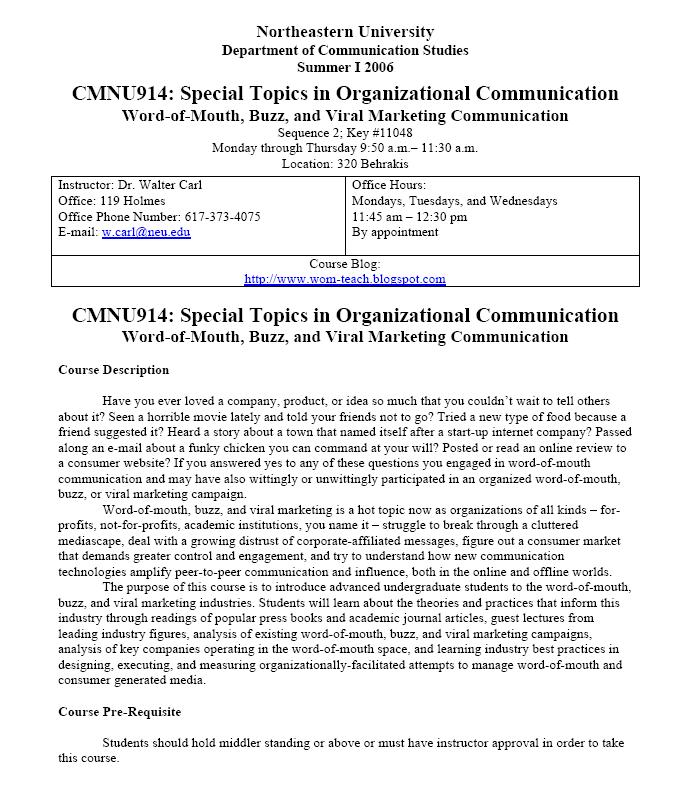
    Back In Business: Syllabus for CMNU914: Word of Mouth, Buzz, and Viral Marketing Communication

    At long last the syllabus is complete! It's a lot of work to design a class from scratch, especially when it's for a topic that is so new and dynamic, but I'm excited about what we're going to cover.

    The enrollment in the course is strong. It now stands at 21, which is quite good for a summer course that wasn't added in time for the course catalog. So of course we built enrollment through word-of-mouth.

    For the first few students who signed up I sent them an e-mail explaining that the course was new and that we needed to reach a certain number (10) to be able to offer the course. I invited them via e-mail to tell their friends who they thought might be interested.

    I also used some other standard marketing strategies for academic courses: a flyer we posted on the walls in the main office and an e-mail blast announcement to the students.

    But the momentum really picked up after my public lecture and my presentation to a student club. These presentations served as a sneak preview of the class and I got a lot of great feedback on them. I'm told by my faculty colleagues and students that this built some nice buzz for the course, and now we're good to go.

    The first class is next Thursday, May 11th (CORRECTION: TUESDAY, MAY 9TH). Check out the near-final draft of the syllabus!

    -->
    Tags:

    Monday, April 24, 2006

    Check Out This Lineup! Inviting Guests To Talk With Class on Word-of-Mouth Marketing Communication

    Sorry for the delay. It's the end of the semester and I'm trying to prepare for the summer class as well as teach my class for the current semester.

    OK, enough excuses, I'm exited to announce a great series of guest speakers who will be visiting the class this summer.
    May 18th: Steve Curran from Pod Design will be speaking on "Viral Marketing and Stimulating WOM and Pass-Along Via Online Gaming" (by the way one of their campaigns was recently awarded the top spot in Marketing Sherpa's Viral Marketing Hall of Fame).

    May 23: Ed Keller from The Keller Fay Group, and co-author of The Influentials, will be speaking on "Influentials: Fact, Fiction, or Cultural Narrative?"

    May 25: Northeastern University's Office of Marketing and Communications will be speaking on "Practitioner Perspective: A Client’s View On Selecting WOM Marketing Companies"

    June 8: Dave Balter from BzzAgent, and co-author of Grapevine: The New Art of Word-of-Mouth Marketing, will be speaking on "Integrating WOM Into the Media Plan"

    June 12: Jim Nail from Cymfony will be speaking on "Thiscompanysucks.com!: How To Deal With Negative WOM"
    I'm honored that these industry leaders agreed to come in to talk with the class and I think it will be a wonderful experience for the students.

    Of course there are many other amazing companies and speakers out there in the word-of-mouth marketing and consumer generated media space who are not on this list. Fortunately for me I'm teaching the class again next Spring so I can hopefully invite them to join us then!

    Students will be blogging about the presentations and discussions we have in class so stay tuned to the blog for more information!

    -->
    Tags:

    Tuesday, March 28, 2006

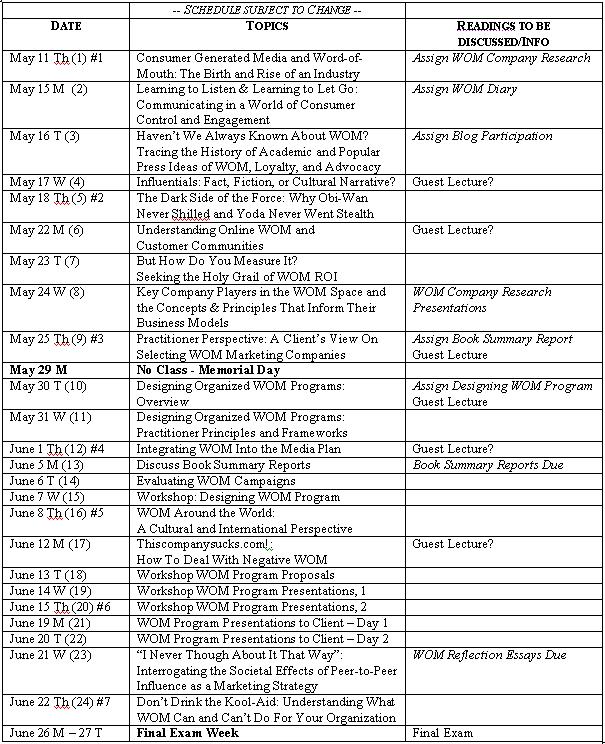
    Laying It All Out: First Draft of Course Schedule for WOM Marketing Course


    OK, I've got my learning objectives now. I know how much time I have. I've got the topics I want to cover and the assignments. I even received some valuable feedback on what I've done so far. Next, I lay it all out in the course schedule (click to open a PDF version of the image above).

    This is just a first draft of course. It may change based on the schedules of the guest lecturers whom I want to invite. A trick of this summer schedule is that it's four days a week over 7 weeks so everything is really compressed. This factor will affect how many, and the complexity level, of the readings I will assign for the students, which will be the subject of a future post.

    -->
    Tags:

    Monday, March 27, 2006

    Feedback on the Course So Far: A View from the Church of the Customer's Jackie Huba

    I recently received some excellent feedback from the Church of the Customers' Jackie Huba, a customer-evangelist-extraordinaire, and co-author (with Ben McConnell) of Creating Customer Evangelists. Jackie looked at the initial framework of the course and gave it a thumbs-up so far. She said that she liked the idea of having students posting and commenting on the course blog and thought the course topics sounded fun to learn about. She also added this helpful note:
    Only feedback I would have is just wondering if you are going to have any discussions of loyalty as it relates to word of mouth. As you know, we believe that WOM is a long-term marketing strategy which comes from 1) having a product/service worth talking about 2) cultivating a passionate base of loyal customers.
    After reading her comment I realized I didn't highlight loyalty in the topics or course objectives. I planned on covering loyalty in the discussion on the academic history of WOM as well as when we covered the six tenets of customer evangelism as part of a module on influential practitioner frameworks for WOM. I agree with her that loyalty, as well as advocacy, are important enough to be highlighted in a title. So here's what I came up with:
    "Haven’t We Always Known About WOM? Tracing the History of Academic and Popular Press Ideas of WOM, Loyalty, and Advocacy"
    Part of this discussion will focus on why customer loyalty and advocacy are especially important in today's marketplace.

    Thanks for the feeback Jackie!

    -->
    Tags:

    Wednesday, March 15, 2006

    Creating Assignments to Fulfill Learning Objectives for the WOM Marketing Communication Course

    I've got my learning objectives now. I can also visually see how much time I have. I've got the topics I want to cover. Now I develop assignments that will create opportunities for the students to demonstrate their understanding of the concepts and skills we're covering. Here's what I have so far, in summary form:

    Word of Mouth Marketing Company Research Project – 10% The purpose of this assignment is to learn more about particular WOMM companies, the types of services they provide, their clients, the backgrounds of the principals, and the WOM concepts and principles that inform their business practice and methodology. You will be required to use at least three sources in your research (for example, internet and/or library searches, interviews, company documents, etc.). Your inquiry will result in an essay of approximately 1500 words.

    WOM Communication Diary and Reflection Essay – 10% The purpose of this assignment is to provide you with an opportunity to reflect on your own WOM practices. Select [X] WOM episodes over a two-week period of time. Complete the Word-of-Mouth Episode Survey online. Write a reflection essay of approximately 1000 words noting patterns in your own behavior and perceptions of WOM communication episodes.

    WOM Book Summary Report – 15%
    Select a popular press book written on WOM, buzz, or viral marketing communication (see suggested list on assignment sheet). Select two chapters from one of these books and review them, drawing upon course concepts to discuss their strengths and weaknesses. The report should focus on how principles or insights can be applied to the final capstone assignment. In addition to the report you will make a brief presentation to the rest of the class summarizing your review.

    Designing Organized WOM Program (Capstone Assignment) – 30% The purpose of this capstone assignment is to pull together all the principles and skills that you have learned in the class. You will work in teams to custom-design a WOM program for a client that has a clear WOM, buzz, and/or viral component. You will prepare a written proposal and present that proposal to the client in class as part of a team presentation.

    Final Exam – 15% [Likely to be a combination of matching, multiple choice, short essay, and a longer essay component.]

    Course Blog Participation – 10% Starting with Class X and running until the end of the term, students must create at least three (3) unique blog posts and must have at least 10 comments to other people’s posts. The content of the posts should be about your experience in the course, and commentary on the readings and concepts. All blogging activity will need to conform to the Course Blogging Guidelines (distributed in class). Assessment will be based on students’ participation in the course blog, with the twin goals of making unique contributions, as well as referencing and building off of each others’ ideas. Students should also follow blogs devoted to WOMM and should post a minimum of three (3) comments on those blogs (students will print out their comments and turn them in). [[NOTE: Does requiring blog participation go against the nature of blogging? Should this be optional?]]

    In-Class Participation & Attendance – 10%
    This portion of your grade includes contributions for in-class discussion, in-class activities, attendance, homework assignments, listening responsiveness, case studies, etc.

    If you were taking this course, what assignments and projects would you like to participate in?

    -->
    Tags:

    Monday, March 13, 2006

    Building Out the Word-of-Mouth Marketing Communication Schedule: Making the Class Topics Sizzle

    After I've worked through my learning objectives and seen what I have to work with in terms of class meeting times, I now think about creating specific class topics.

    In my past syllabi the titles for what we would do each day were a bit bland, like "Basic Principles of Topic X" or "Applications of Topic Y". This time around I'm trying to add a little sizzle. Here are some that I've come up with (I invite suggestions on other topics to include as well as jazzing up some of these topic titles):
    • Consumer Generated Media and Word-of-Mouth: The Birth and Rise of an Industry

    • What’s the Difference Between WOM, Buzz, and Viral Marketing? Who Says So and Why Should I Care?

    • Learning to Listen: Wake Up! Consumers Are Talking About You… You Better Learn From It

    • Learning to Let Go: What Control Freaks Need to Learn in a World of Consumer-Control and Engagement

    • Kickin’ It Old School: Haven’t We Always Known About WOM? Tracing the History of Academic and Popular Press Ideas of WOM

    • Influentials: Fact, Fiction, or Cultural Narrative?

    • The Dark Side of the (WOM) Force: Why Obi-Wan Never Shilled and Yoda Never Went Stealth

    • Avoid the Hype! Key Company Players in the WOM Space and the Concepts & Principles That Inform Their Business Models

    • Evangelists, Ambassadors, and Bees: Exploring the Rhetorical Metaphors of WOM Industry Practice

    • Why “WOM vs. Advertising” is a Stupid Idea (But It Sure Gets People Talking!): Integrating WOM Into the Media Plan

    • Practitioner Principles and Frameworks for Organizing WOM [This one needs to be jazzed up some]

    • Who Said You Can’t Measure WOM? Seeking the Holy Grail of WOM ROI

    • Finding the Inner Anthropologist In All of Us: Why Understanding WOM May Be More Important than Measuring It

    • Mapping the Conversational Geography of WOM: The Conversational and Relational Basis of WOM

    • Learning from Consumer Communities and Online WOM [Important topic, but boring title -- need to change]

    • Blogging Your Way to a Better Tomorrow: Using Blogs and Avoiding Synthetic Transparency

    • Thiscompanysucks.com!: How To Deal With Negative WOM

    • “I Never Though About It That Way”: Interrogating the Societal Effects of Peer-to-Peer Influence as a Marketing Strategy

    • Don’t Drink the Kool-Aid: Understanding What WOM Can and Can’t Do For Your Organization
    I'll need to sequence these on the schedule but before I do that I'll put some time into creating assignments that tie to the learning objectives and the class content.

    -->
    Tags:

    40 Hours of WOM


    After I write my learning objectives I like to make a table of the dates I have to work with. My class will take place during "Summer 1" which runs from May 11 - May 27. The class will meet four times a week, for six weeks. This will give us 24 class periods at 100 minutes each. 2400 minutes to work with. 40 hours of WOM.

    CORRECTION: THE TERM ACTUALLY STARTS ON TUESDAY, MAY 9th. THUS THERE ARE ACTUALLY 26 CLASSES, OR 43 1/3 HOURS. DOESN'T HAVE QUITE THE SAME RING TO IT DOES IT?!?)

    -->
    Tags:

    Friday, March 10, 2006

    Learning Objectives For A Course on WOM, Buzz, and Viral Marketing Communication

    This is how it begins. When I design a new course I start with what I want the students to take away at the end. Here's a list that I came up with.

    By the end of this course you should be able to:

    • Identify factors contributing to the recent resurgence in word-of-mouth (WOM);
    • Trace the history of academic and popular press ideas that inform the current WOM, buzz, and viral marketing industry;
    • Articulate how WOM is both a set of activities and a larger philosophy;
    • Identify reasons why consumers engage in WOM;
    • Compare and contrast characteristics of everyday (organic) and organized (amplified) WOM;
    • Apply effective strategies of monitoring, tracking, and listening to consumer WOM in both online and offline venues;
    • Demonstrate how WOM concepts and principles inform a WOMM company’s business practices;
    • Integrate effectively WOM principles into an organization’s business practices;
    • Measure and track ROI and other key outcome metrics for organized WOM programs;
    • Distinguish between ethical and unethical WOM practices;
    • Reflect critically on your own WOM communication practices.

    What else should students come away with?

    -->
    Tags:

    Thursday, March 09, 2006

    Building A Course on Word-of-Mouth, Buzz, and Viral Marketing Communication

    Over the next few weeks I will be blogging about my preparations for my new special topics course on word-of-mouth, buzz, and viral marketing communication.

    The goal is to provide students and anyone else who is interested a sense of my thinking in designing the course and to invite comments to help make the course a better learning experience.

    It begins now...

    -->
    Tags: